CLike at a glance
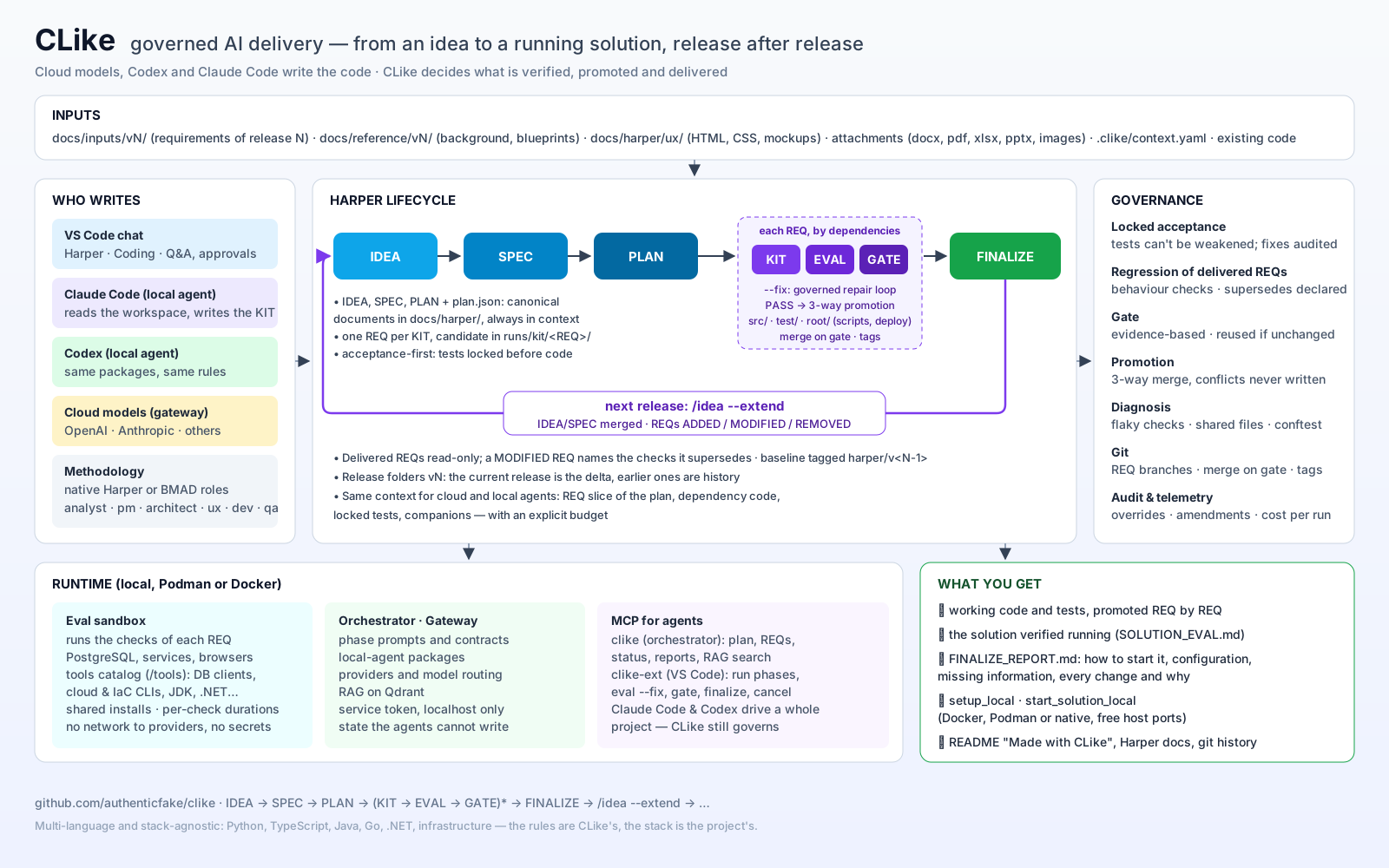
CLike turns an idea into a running, documented solution — and keeps evolving it release after release — while AI does the writing and CLike decides what is verified, promoted and delivered. This page walks through the picture area by area, with links to the details.
Inputs
What a project starts from, read by the phases as context (never as instructions):
docs/inputs/vN/— the requirements of release N (docx, pdf, xlsx, pptx, md…). The current release is the delta; earlier releases and unversioned inputs are history.docs/reference/vN/— background: blueprints, provider catalogs, documentation of an existing system.docs/harper/ux/— what the UI must look like: HTML prototypes, CSS, mockups, UX notes.- Attachments of a command,
.clike/context.yaml(which files each phase reads, with which role), and the existing code of the project.
Details: context-sources.md, commands.md.
Who writes
- VS Code chat — three modes: Harper (the lifecycle), Coding, Q&A; with approvals for agent actions.
- Claude Code and Codex as local agents — they read the workspace and write the KIT candidate, under the same packages and write rules.
- Cloud models through the gateway (OpenAI, Anthropic, others) — they receive the same context a local agent would read, within an explicit budget.
- Methodology — native Harper, or BMAD roles per phase (analyst, pm, ux, architect, developer, qa, tech-writer) as guidance; CLike’s contracts always win.
Details: local-agents.md, integrations/bmad/COMMANDS.md.
Harper lifecycle
IDEA → SPEC → PLAN → ( KIT → EVAL → GATE )* per REQ → FINALIZE
- IDEA, SPEC, PLAN — the canonical documents in
docs/harper/(withplan.json, the REQs), always in context. - KIT — one REQ at a time, as a candidate in
runs/kit/<REQ>/: code (src/), tests (test/), eval profile (ci/), docs, and repository-root files (root/: scripts, deploy). With acceptance-first the tests are written and locked before the code. - EVAL — the REQ’s checks in the sandbox, plus the regression of the delivered REQs;
--fixruns a governed repair loop from the real failures. - GATE — the decision from the evidence; on PASS the candidate is promoted with a 3-way merge and, if configured, merged into the default branch.
- FINALIZE — the whole solution installed, configured, started and smoke-checked; the developer gets the report and the scripts to run it.
Details: harper-workflow.md, auto-eval.md, git-and-promotion.md.
The next release
/idea --extend evolves a delivered project: the new release (docs/inputs/vN/) is merged into
IDEA, SPEC and TECH_CONSTRAINTS, and the PLAN receives new REQs typed ADDED, MODIFIED
(naming the checks of a delivered REQ it supersedes) or REMOVED. Delivered REQs stay
read-only, the baseline is tagged v<N-1>, and an EXTEND report carries CLike’s own
verification. Then the same loop runs on the new REQs.
Details: commands.md (/idea --extend), architecture/ADOPT_AND_IDEA_EXTEND.md.
Governance
- Locked acceptance — tests cannot be weakened; a test fix is audited and marked for review.
- Regression of delivered REQs — their behaviour checks run with every candidate; a declared change supersedes only the checks it names.
- Gate — evidence-based; when nothing changed since a passing eval, its verdict is reused.
- Promotion — 3-way merge per file; a conflict is never written, it is reported.
- Diagnosis — flaky checks, shared files a candidate replaced, a shared conftest dropped.
- Git — REQ branches, merge on gate, tags per phase and release.
- Audit and telemetry — overrides, amendments, cost per run.
Details: auto-eval.md, ../SECURITY.md.
Runtime
Everything runs locally with Podman or Docker:
- Eval sandbox — runs the checks with PostgreSQL, services and browsers; installs native tools
from a catalog on request (
/tools); shares installs; no network to providers, no secrets. - Orchestrator and gateway — phase prompts and contracts, local-agent packages, providers and model routing, RAG on Qdrant; service token, localhost only, state the agents cannot write.
- Memory panel — the project’s RAG memory and CLike’s own guide, queried in any language next to the chat; the memory follows the KITs (files removed from a KIT leave it).
- Release from
/finalize— a passing finalize checks the local start on the developer’s machine, names the release and its REQs in its commit, tags itvNand writes the release notes from the documents; publishing the release is the developer’s confirmation. - MCP for agents —
clike(orchestrator) reads plan, REQs, status, reports, RAG;clike-ext(VS Code) runs the phases,eval --fix, gate, finalize. Claude Code and Codex can drive a whole project, and CLike still governs every step.
Details: setup-and-runtime.md, mcp.md, howto-mcp-project.md, howto-mcp-bmad-claude.md.
What you get
- Working code and tests, promoted REQ by REQ.
- The solution verified running (
docs/harper/SOLUTION_EVAL.md). docs/harper/FINALIZE_REPORT.md— how to start and see it, every configuration variable, the information only you can give, every change and why.scripts/setup_localandscripts/start_solution_local— Docker, Podman or native, with free host ports.- A README marked Made with CLike, the Harper documents, a readable git history.
CLike is multi-language and stack-agnostic: Python, TypeScript, Java, Go, .NET, infrastructure — the rules are CLike’s, the stack is the project’s.